Start With The Compass
Before anyone talks fabric, we want to know which way each window faces. On this side of Pretoria that single question settles most of the decision.
North-facing glass takes the low winter sun deep into the room, which is a gift in July and a nuisance by October. South stays even and cool all year and often needs the least. East loads up early and is done by mid-morning. West is the one that causes the phone calls: from roughly three in the afternoon through summer the sun arrives almost level with the glass, under every overhang, straight onto the TV and the floors. A 5% sunscreen on a west elevation and a 10% on a south elevation are not the same blind doing the same job, even though the price list puts them a line apart.
Three Fabrics, Three Different Jobs
- BlockoutCoated fabric, no light through it. Bedrooms, nurseries, media rooms — and a useful bit of insulation on big glass.
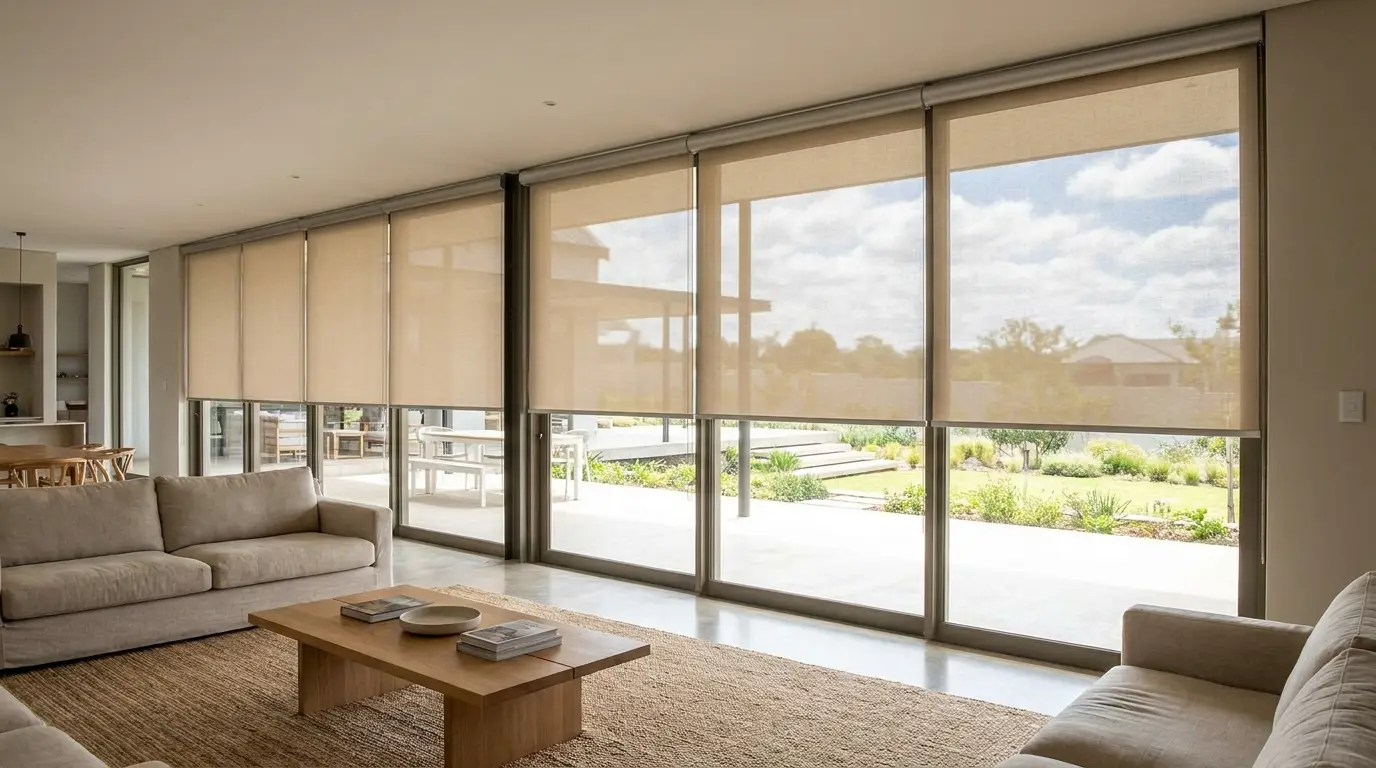
- SunscreenAn open weave rated 3%, 5% or 10%. The lower the number, the tighter the weave: more glare and heat stopped, less view left.
- Day/nightAlternating sheer and solid bands on one roll. Line them up for privacy, offset them for a soft filtered light, all off one chain.
Sunscreen is a daytime fabric only. After dark, with the lights on inside, it works in reverse and the room reads out to the garden. That is the one thing worth knowing before you put it in a bedroom on its own. A double bracket solves it — sunscreen and blockout on the same fitting, each on its own chain — and costs less than fitting twice.
The Numbers That Get Decided On Site
A roller blind runs to about three metres of fabric width before it wants a centre join. Plenty of openings here are wider than that, so at the measure we either place the join where a mullion already breaks the line, or split it into two blinds and link the motors so they travel together.
Depth matters too. A boxed cassette needs somewhere around 100mm of clear space to sit in, which is easy under an open ceiling and awkward once a bulkhead is closed up. If your house is still on site, that is a five-minute conversation with the builder now and a compromise later. Stacking doors have their own catch: the top track sits proud of the wall, so the bracket has to clear it or the fabric fouls the doors every time they slide.
Chain, Spring Or Motor
Chain is the default. It comes with a child-safe tensioner screwed into the wall, which holds the loop taut instead of leaving it hanging where a small child can reach it.
Spring-assist suits the smaller windows that get opened and closed all day — a bathroom, a scullery, a study.
Motors earn their money on the tall stuff: double-volume stairwells, the top row of a window wall, or a bank of blinds you would rather set once from a remote. Rechargeable battery motors are the practical choice here, because they carry on working when the power does not. The automation page covers what that costs and where it is not worth the spend.
Where We Would Talk You Out Of One
Rollers are not the answer everywhere. A very wide unbroken span will always show its join. A window with deep glazing bars or a more traditional facade usually looks better under a timber or aluminium venetian, where the tilt does the work instead of the drop. And if what you are fighting is heat arriving at the outside of the glass rather than glare bouncing around inside, an external roller shutter stops it before it reaches the room — a roller blind can only deal with it afterwards.
Questions We Get On This Estate
Can you measure before we have moved in?
Yes, and it is the better order. Once the floors are down and the ceilings are closed we can measure properly, and the blinds can be up before the furniture arrives. Bring us in earlier than that and we will mark up where a recess or a cassette needs to be allowed for.
Does the estate have to approve them?
Interior blinds sit behind your glass, so they are your business. Anything that lives on the outside of the wall — a shutter, an awning — normally goes through your HOA's aesthetic guidelines first. Ask them what they need and we will supply the drawings, colours and finishes in whatever format they want them.
A stand near us is still being built. Will the dust ruin the fabric?
No. Blockout and sunscreen both wipe down with a damp cloth, and an open sunscreen weave sheds dust more easily than a woven curtain does. If there is active building right outside a particular room, we would just hold off on the palest fabric in that room until the worst of it has passed.
How long from measure to fitted?
You get a lead time in writing with your quote rather than a number off a web page, because it moves with the fabric you choose. What we will not do is promise a week and arrive in five.